Ultralytics YOLO-Depth
Predict the distance to every visible surface from a single RGB image. YOLO26 depth models add metric 3D spatial awareness without specialized depth sensors, stereo cameras, or lidar.
YOLO26 depth estimation models
YOLO26-depth models predict a dense depth map in meters from one RGB image. Five model sizes span edge deployment through accuracy-critical spatial analysis, with released weights pretrained on approximately 2.19 million indoor and outdoor images and evaluated on the NYU Depth V2 Eigen test split.
pip install ultralyticsfrom ultralytics import YOLO
# Load a YOLO26 depth model
model = YOLO("yolo26n-depth.pt")
# Predict metric depth at the model training resolution
results = model("image.jpg", imgsz=768)
depth_map = results[0].depth.data.cpu().numpy()| Model | Size (px) | delta1 | abs_rel | RMSE (m) | Params (M) | FLOPs (B) |
|---|---|---|---|---|---|---|
| YOLO26n-depth | 768 | 0.882 | 0.109 | 0.414 | 6.4 | 46.9 |
| YOLO26s-depth | 768 | 0.896 | 0.104 | 0.399 | 13.2 | 67.9 |
| YOLO26m-depth | 768 | 0.921 | 0.089 | 0.364 | 23.3 | 130.7 |
| YOLO26l-depth | 768 | 0.930 | 0.083 | 0.351 | 27.7 | 157.2 |
| YOLO26x-depth | 768 | 0.933 | 0.080 | 0.344 | 57.0 | 302.0 |
YOLO26 depth estimation benchmarks on the NYU Depth V2 Eigen test split with multi-scale and horizontal-flip TTA plus log-least-squares alignment; parameters and FLOPs are measured at 768 × 768.
Trusted by the world's leading organizations












Our models' impact
Streamline processes across industries with our cutting-edge vision AI models. Speed, accuracy and ease-of-use powered by Ultralytics.
The evolution of Ultralytics YOLO models
See how Ultralytics YOLO evolved from the practical YOLOv5 workflow to edge-ready YOLO26 inference.
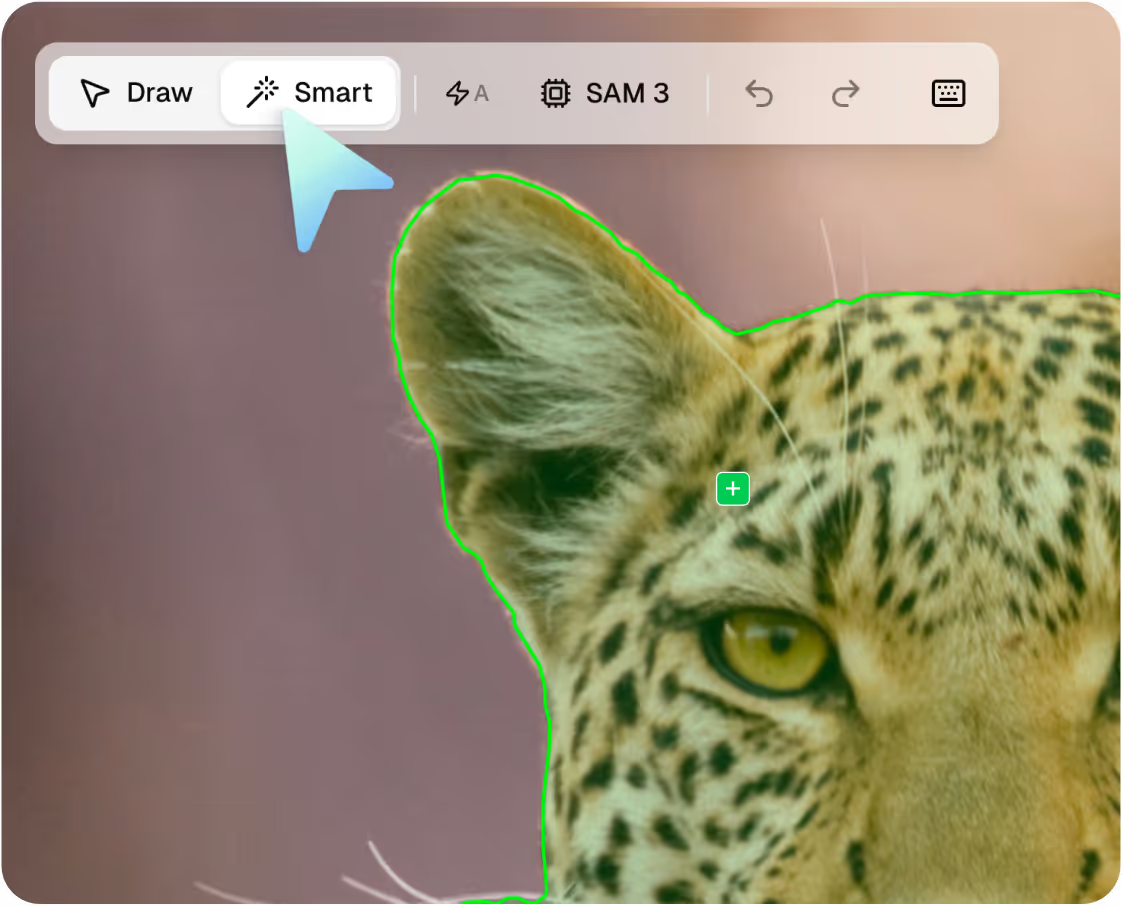
Label up to 10x faster with smart annotation
Ultralytics Platform gives you the image annotation tool to build high-quality datasets faster. From smart annotation to precise manual editing, these features are designed to reduce image labeling time without sacrificing quality.
- SAM-powered smart annotation: Masks and bounding boxes in one click.
- Full AI task coverage: Detection, instance segmentation, semantic segmentation, classification, pose, OBB.
- Universal format support: Your choice of YOLO, COCO, and more.
- Team review and versioning: Clear collaboration at every step.
Train on the Best GPUs for Less
26 NVIDIA GPUs starting at $0.24/hr — from Ampere to Blackwell. No markup, no minimums, no commitment.
Explore industry solutions
See how teams apply Ultralytics computer vision across production environments.

Agriculture

Automotive

Healthcare

Logistics

Manufacturing

Retail

Robotics
Agriculture
Automotive
Healthcare
Logistics
Manufacturing
Retail
Robotics
Agriculture
Automotive
Healthcare
Logistics
Manufacturing
Retail
Robotics
Frequently asked questions
Ultralytics YOLO-Depth is the YOLO26 model family for monocular depth estimation: predicting a dense per-pixel depth map in meters from one ordinary RGB image. Official pretrained checkpoints are available in five sizes, from YOLO26n-depth through YOLO26x-depth.
Depth turns 2D detections into 3D understanding: how far away an obstacle is, how large an object really is, and how a scene is laid out. Doing this from one standard camera avoids the cost, calibration, and integration burden of lidar and stereo rigs, which makes spatial awareness practical for robotics, mobility, and everyday camera systems.
Each prediction returns one dense float depth map aligned to the input image. Access it through
result.depth.data; its values represent distance in meters and can be converted to a NumPy array for 3D reconstruction, navigation, measurement, or visualization. See the depth prediction guide for the complete result contract.Yes. Pair each RGB image with a float32 depth map in meters and fine-tune a pretrained YOLO26-depth checkpoint with the standard Ultralytics train mode. The official guide recommends AdamW and a low learning rate when adapting released weights to a custom depth domain.
Use export mode to convert a YOLO26-depth checkpoint to formats including ONNX, TensorRT, CoreML, and OpenVINO. You can then run the exported model through the same Ultralytics prediction workflow on edge, mobile, or server hardware.
Build with Ultralytics YOLO-Depth
Train, validate, export, and deploy YOLO26 depth estimation models with Ultralytics Platform.